
Fillmore County Arrest Records and Court Charges
Fillmore County arrest records begin with law enforcement. The Sheriff's Office, jail, or a police department may create records tied to an arrest, booking, custody, fingerprinting, or incident report. The court charge record begins later, when the County Attorney reviews the referral and files formal charges in District Court. That filing can create a public criminal case record if the case is not sealed, confidential, or restricted from remote access.
The Sheriff's Office and Fillmore County Jail are at 901 NW Houston Street in Preston. The jail FAQ and sheriff services pages document jail contacts, warrant guidance, fingerprinting, VINE, bail or bond notes, and the sheriff data-request route. For custody and roster details, use the jail records path. For the full case file, disposition, plea, and sentence, use Fillmore County criminal court records.
The Fillmore County Sheriff page is the assigned law-enforcement source for arrest records and charge routing.
The sheriff source anchors the arrest side of the pathway before a charge becomes part of a District Court case.
Search Fillmore County Arrest Records and Charges
Start with the record type needed. If the question is whether someone is currently in custody or recently booked, use the Fillmore jail roster and jail contact route. If the question is what charges were filed after arrest, use MCRO Case Search and select Fillmore County and the Criminal case category. If the question is a statewide criminal-history check, use BCA CHS instead of MCRO.
- Check the county jail roster or jail office when the need is current custody or booking confirmation.
- Use MCRO Case Search for formal criminal charges filed in Fillmore County District Court.
- Search by case number when a pending criminal matter does not return by defendant name.
- Read each charge with its current status, hearing history, disposition, and sentence fields.
- Use sheriff data requests for law-enforcement reports or booking data not posted online.
The Fillmore County Sheriff services page says to complete the top portion of the Sheriff's Office Data Request Form and return it to the sheriff or email it to bharmening@co.fillmore.mn.us.
That request route is the practical fallback for sheriff records that do not appear in MCRO because they are not court case records.
Fillmore Charges After Arrest
After an arrest, the charge record depends on prosecutor filing. The Fillmore County Attorney prosecutes all felonies in the county, most gross misdemeanor and misdemeanor cases outside municipalities, and all juvenile matters wherever they occur in Fillmore County. The filed charging document may identify the statute, offense level, complaint date, prosecutor, arresting agency, bail condition, and first appearance information when public.
| Charging Document | Who Uses It | What It Does |
|---|---|---|
| Complaint | Common Minnesota criminal filing after law-enforcement referral and prosecutor review. | Starts the court case and lists allegations, statutes, facts, and requested court action. |
| Information | Prosecutor-filed charging document where procedure allows that route. | States the formal charge without relying on the arrest record alone. |
| Indictment | Grand-jury charging document for serious cases where that process is used. | Brings formal charges based on grand-jury action rather than a simple booking entry. |
The Fillmore County Attorney biography page is assigned to the arrest and court-charge record set.
The prosecutor source helps explain why charges after arrest are not the same thing as the arrest event itself.
Fillmore Charge Status Table
Charge status can change before a case ends. A criminal case may begin with one charge level and later show amended, reduced, dismissed, or sentenced entries. MCRO warns that a case type listed in search results is not necessarily the final outcome. Read the Register of Actions and disposition fields before drawing conclusions from an original charge line.
| Status | What It Means | Where to Check |
|---|---|---|
| Filed or pending | The prosecutor filed the allegation and the case has not reached final disposition. | MCRO case record and hearing list. |
| Amended | The charge was changed after filing, often by prosecutor action or plea process. | Register of Actions and charge list. |
| Reduced | The case or charge level resolved at a lower severity than first listed. | Disposition and sentence entries. |
| Dismissed | The court record shows that a charge or case was dismissed rather than convicted. | Charge-specific disposition field. |
| Sentenced | A conviction or plea led to sentence terms, probation, fines, restitution, or custody entries. | Sentencing order and case events. |
Charges vs Convictions in Fillmore County
A charge after arrest is not proof of guilt. It is the allegation filed with the court. A conviction is a final result after a guilty plea, verdict, or other judgment of guilt. Fillmore County arrest records and charge records can therefore show allegations that were later changed, dropped, dismissed, or resolved differently at sentencing.
| Point | Charge | Conviction |
|---|---|---|
| Record stage | After arrest and prosecutor filing. | After plea, finding, or judgment. |
| Meaning | Formal accusation in court. | Final guilt outcome for a charge. |
| Can change? | Yes, it may be amended, reduced, or dismissed. | The final result is read from disposition and sentence fields. |
| Best source | MCRO charge and docket entries. | Disposition, sentencing order, and BCA history where applicable. |
Note: Always read the final disposition before treating an original court charge as the case outcome.
Fillmore Prosecutor and Defense Contacts
The Fillmore County Attorney is Brett Corson. The office is listed at 101 Fillmore St., P.O. Box 466, Preston, MN 55965, with phone (507) 765-2530 and regular weekday hours. The attorney page explains the office's criminal prosecution role and its work with law-enforcement and justice partners.
The public defender path is separate from prosecution. Fillmore Court Administration phone materials list the Public Defender Rochester number as (507) 285-7370. The Minnesota State Law Library Fillmore referrals page lists the Third Judicial District Public Defender Rochester Office at 206 South Broadway, Suite 500, Rochester, for eligible criminal and juvenile delinquency representation. Public defender assignments are made by District Court, and public defender questions route through Court Administration.
The Minnesota Board of Public Defense office list is assigned to Fillmore arrest and charge records.
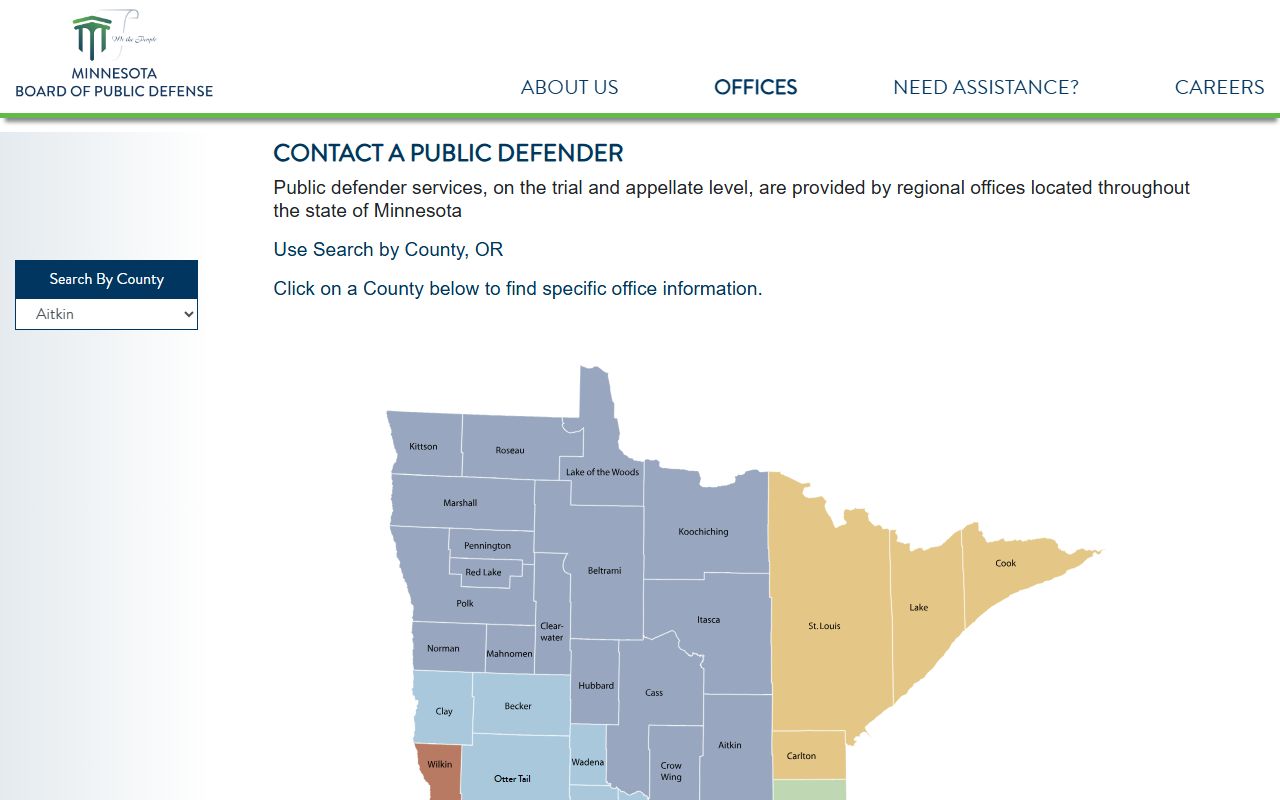
That source is useful because first appearance, charge review, and court-appointed representation often arise soon after arrest.
The Minnesota State Law Library Fillmore referrals page gives county-specific legal referral context.
The referrals source supports the local public defender contact and separates legal help from record lookup.
Fillmore Charge Codes and Severity
Charge entries may include a statute number, offense level, complaint date, prosecutor, arresting agency, bail condition, and first appearance. Minnesota offense levels in the research include felony, gross misdemeanor, misdemeanor, and petty misdemeanor. One arrest can lead to more than one charge, and each charge can have a different status or final result.
Felonies are the most serious level and are prosecuted by the Fillmore County Attorney when they occur in the county. Gross misdemeanors and misdemeanors may also be prosecuted by that office for most cases outside municipalities. Petty misdemeanor matters are often fine-level cases, but they can still create court entries and payment or appearance duties. A court record should be read by charge, not only by case caption.
Statewide Charge and History Checks
The Minnesota BCA Public Criminal History Search is the state criminal-history route. Research identifies BCA CHS as the better channel for background-check style criminal history because MCRO is not fingerprint based and is not a criminal-history repository. MCRO is still the court case source for Fillmore charges, hearings, dispositions, and sentences.
For sheriff records, use the sheriff data request process. For certified court copies, use Fillmore Court Administration. For jail custody status, use the jail roster and jail office. For statewide public criminal history, use BCA CHS. The same incident can touch all of these systems, but each has a different record owner and access rule.
Restricted Fillmore Arrest and Charge Records
Not every arrest or charge record is public online. Juvenile delinquency and child-protection case types are restricted. Domestic Abuse/OFP and harassment restraining order case types are not available through MCRO because of federal internet-display limits. Civil commitment public documents are not shown through MCRO. Expunged or sealed criminal records may be blocked from public view under Minn. Stat. chapter 609A or a court order.
- Sealed record
- A record restricted from routine public view by court rule, statute, or order.
- Expunged record
- A record sealed from public view when Minnesota expungement relief applies.
- Agency reach
- The systems affected may vary by order, statute, court file, and agency record.
The Preston Police Department contact page is assigned to arrest and charge records because city police contact can be part of the local arrest side.
Police contact information may help with agency routing, but formal court charges still route through District Court once filed.