
Search Fillmore County Court Records
Most public Fillmore County court records start with Minnesota Court Records Online Case Search, often called MCRO. MCRO is the statewide public case-search system for Minnesota District Court records, including Fillmore County District Court. It can show case results, Registers of Actions, hearing information, monetary judgment details, and some public documents. It is not the official certified court record. The Minnesota Judicial Branch states that certified copies and certified civil judgment search results must come from local court administration.
The local fallback is Fillmore County Court Administration at the courthouse in Preston. Use the courthouse office when MCRO does not show a case because of remote-access limits, when a public document is not available online, or when a certified copy is needed for court, licensing, school, employment, or another formal use. For county-government records outside the state court file, the Fillmore County Data Privacy process is separate. For law-enforcement reports, booking data, or sheriff records, the sheriff data request route is the better channel.
- Open MCRO Case Search and choose the tab that fits the information available: name, case number, citation number, or attorney.
- For a county-only search, select the county location option and choose Fillmore from the county list.
- Use case categories such as Civil, Criminal, Family, or Probate or Mental Health to narrow broad name searches.
- Open the case result and read the Register of Actions, hearing entries, case status, and public documents if available.
- Contact Fillmore County Court Administration for certified copies, missing public documents, or courthouse-terminal access.
The Fillmore court administration phone page is one of the best source points for local court contact numbers.
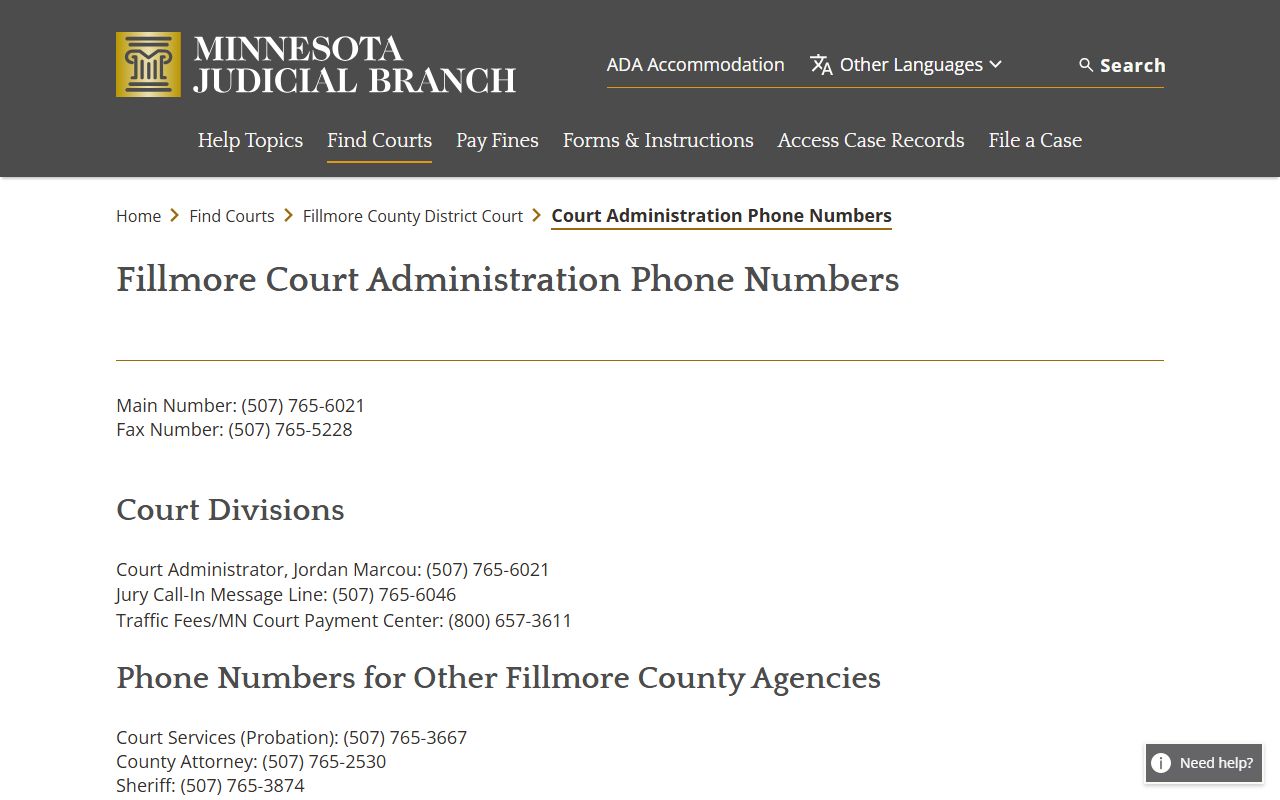
That contact page matters because it separates court administration, jury service, traffic fees, sheriff, jail, probation, public defender, victim services, and county attorney numbers.
Fillmore County District Court
Fillmore County does not have a separate county court, justice court, municipal court, or stand-alone probate court for ordinary court-case jurisdiction. Minnesota uses District Court as the unified state trial court. The official Fillmore County District Court page says the court has original jurisdiction in civil, family, probate, juvenile, criminal, and traffic cases filed in Fillmore County. That means most state court records in the county route through one local District Court office rather than through several lower courts.
Fillmore County is part of the Third Judicial District, an administrative district for southeast Minnesota. The district includes Dodge, Fillmore, Freeborn, Houston, Mower, Olmsted, Rice, Steele, Wabasha, Waseca, and Winona counties. The Minnesota Judicial Branch describes the district courts as the courts where most cases begin, with appeals moving to the Minnesota Court of Appeals and then, in limited matters, to the Minnesota Supreme Court.
The Minnesota court system overview explains how trial and appellate courts fit together.
For Fillmore County users, the practical path is simple: local trial cases begin in District Court, online access starts in MCRO, and appellate review creates a separate appellate record only if a final order is appealed.
| Court or office | Role | Record access use |
|---|---|---|
| Fillmore County District Court | Unified trial court | Civil, family, probate, juvenile, criminal, and traffic case files |
| Third Judicial District | Administrative district | District policy, judges, administration, and regional court operations |
| Minnesota Court of Appeals | Intermediate appellate court | Appeals from final District Court decisions and some agency decisions |
| Minnesota Supreme Court | Court of last resort | Discretionary review and matters within supreme court authority |
Fillmore County Court Record Types
Fillmore County court records cover several case classes. Civil files may contain complaints, summonses, answers, motions, affidavits, orders, judgments, settlement notices, and satisfactions of judgment. Criminal files may contain complaints, charges, bail or bond entries, plea records, hearing minutes, sentencing orders, warrants when public, probation terms, restitution, fines, and discharge entries. Family files may include divorce, custody, parenting time, child support, paternity, and related orders, though some child and financial details are restricted.
Probate records are District Court records in Fillmore County, not a separate county probate court file. Traffic and petty misdemeanor cases are also District Court records in Minnesota, though payment and citation lookup often use the Minnesota Court Web Payment system. Juvenile, child protection, civil commitment, and protective-order cases have tighter public access rules. A public case may exist while specific documents, street addresses, comment fields, or party details stay unavailable online.
- Civil records: claims, judgments, motions, orders, and conciliation court matters.
- Criminal records: charges, hearings, pleas, dispositions, sentencing, fines, restitution, and probation terms.
- Family records: divorce, custody, parenting time, support, and paternity files with redactions.
- Probate records: estates, wills, informal and formal probate, guardianship, and conservatorship records.
- Traffic records: citation cases, petty misdemeanors, payment status, court dates, and dispositions.
The Judicial Branch filing overview is useful for understanding why most Minnesota cases start in District Court.
Because the same District Court handles many record types, the better search choice is often the case category, not a different courthouse.
Fillmore County MCRO Limits
MCRO gives broad public access, but it does not show every Fillmore County court record. The Judicial Branch notes that domestic abuse order-for-protection cases and harassment restraining order cases are not available through MCRO because of federal VAWA restrictions. Child protection and Juvenile Delinquency Felony 16 case types are not shown. Public documents in civil commitment case types are not available online. Party street addresses and some comment fields are also not available remotely, although criminal sentencing condition comments may display.
A key criminal and traffic limit affects name searches. Pending criminal, traffic, and petty misdemeanor cases without a conviction will not return in MCRO name-search case results or hearing results when searched by defendant name. Those cases may return when searched by case number. For that reason, a citation number, case number, hearing notice, or other official paperwork can be more reliable than a name alone.
The Judicial Branch access case records page links the statewide record channels used by Fillmore County searchers.
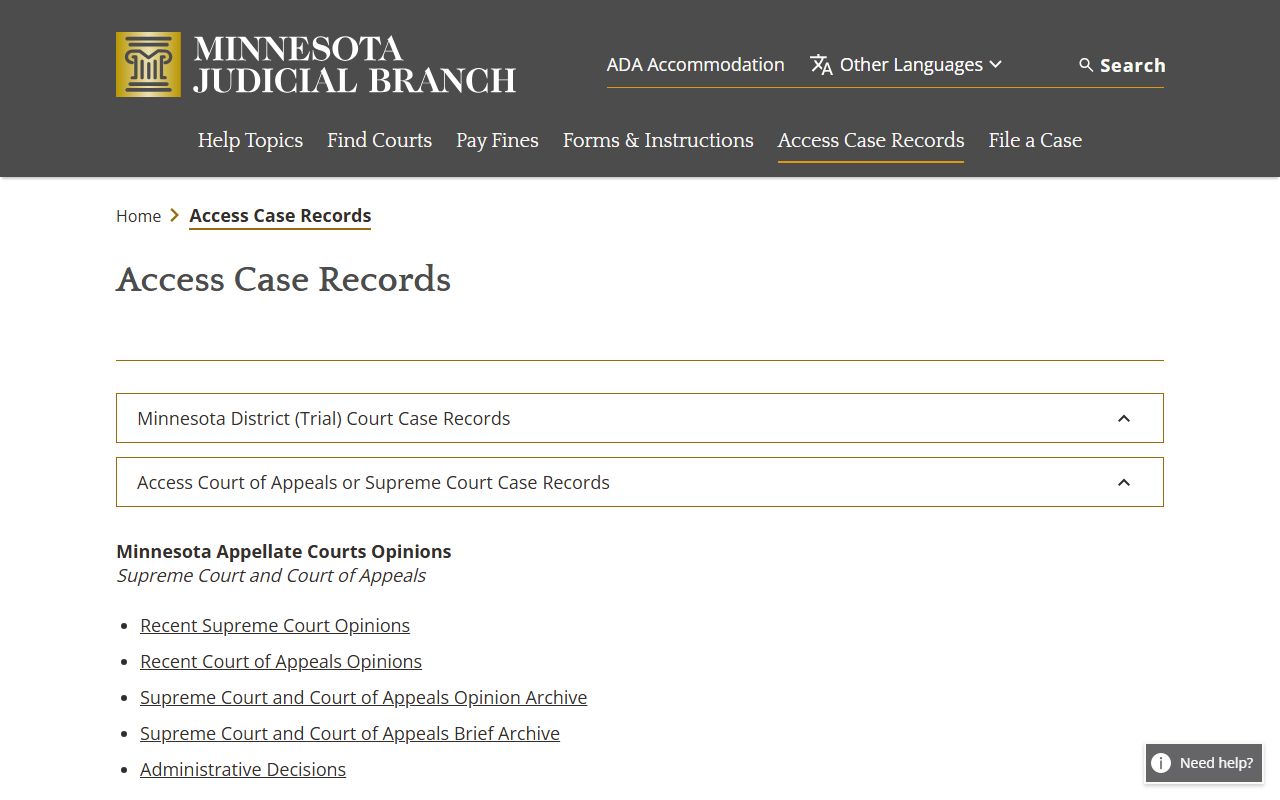
When online access stops, the record path does not end. It shifts to Court Administration, a courthouse terminal, a certified-copy request, or a different official agency.
| MCRO field | Use in Fillmore County searches |
|---|---|
| Name tabs | Search a person or business by name, with optional date and county filters. |
| Case number | Best for known cases, including pending cases that may not show by defendant name. |
| Citation number | Useful for traffic and petty misdemeanor matters tied to a ticket. |
| Case category | Filters Civil, Criminal, Family, and Probate or Mental Health case groups. |
| Court location | Use Fillmore for county-only results or statewide for a broader Minnesota search. |
Fillmore County Public Access Laws
Public access to Fillmore County court records comes from a mix of state court rules and Minnesota data law. Court records are governed by the Minnesota Rules of Public Access to Records of the Judicial Branch. County-government data is governed by the Minnesota Government Data Practices Act. Criminal-history data has its own statute, and expungement is handled under a separate Minnesota chapter. These rules explain why a record can be public at the courthouse but missing from remote online access.
Key Statutes and Rules:
Minn. Stat. 13.03 says government data are public unless a law classifies them otherwise.
Minn. Stat. 13.025 requires data access policies and responsible authority contacts.
Minn. Stat. 13.87 governs public criminal-history data and the BCA public search.
Public Access Rule 4 defines court-record access and exceptions.
Minn. Stat. ch. 609A covers criminal expungement and sealing.
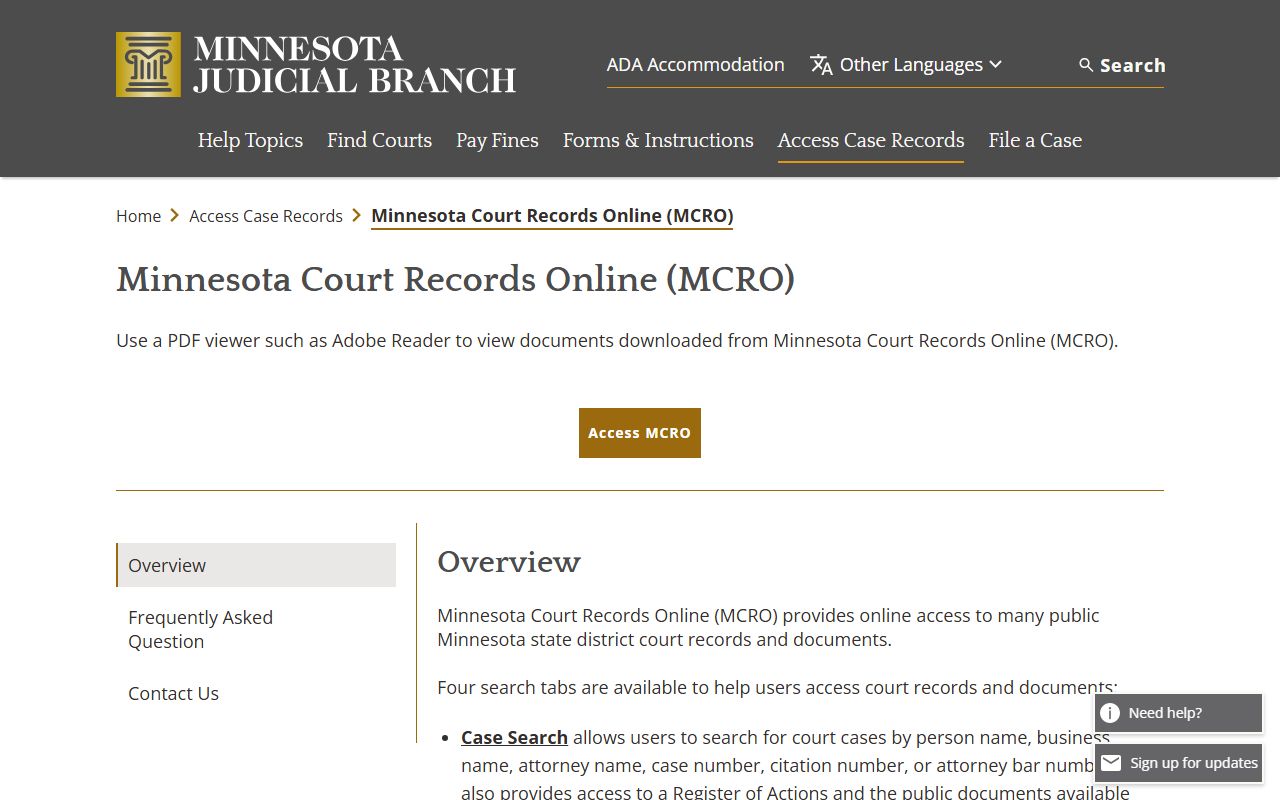
The MCRO information page explains the court system's online access model for Minnesota trial court records.
For county data outside the Judicial Branch, Fillmore County names the County Administrator as the public information and data privacy officer.
Fillmore County Court Records Fees
Online MCRO searching is free, but official copies and filings can involve fees. The Minnesota Judicial Branch district court fee page should be checked for the current Fillmore County setting before filing or ordering copies. The research file identifies state fee examples for certified and exemplified court copies, plus local county fees for Recorder, marriage, and jail fingerprinting services. Those county fees do not replace court fees, but they help users route non-court record requests to the right office.
The Minnesota district court fee page is the source for current court fee checks.
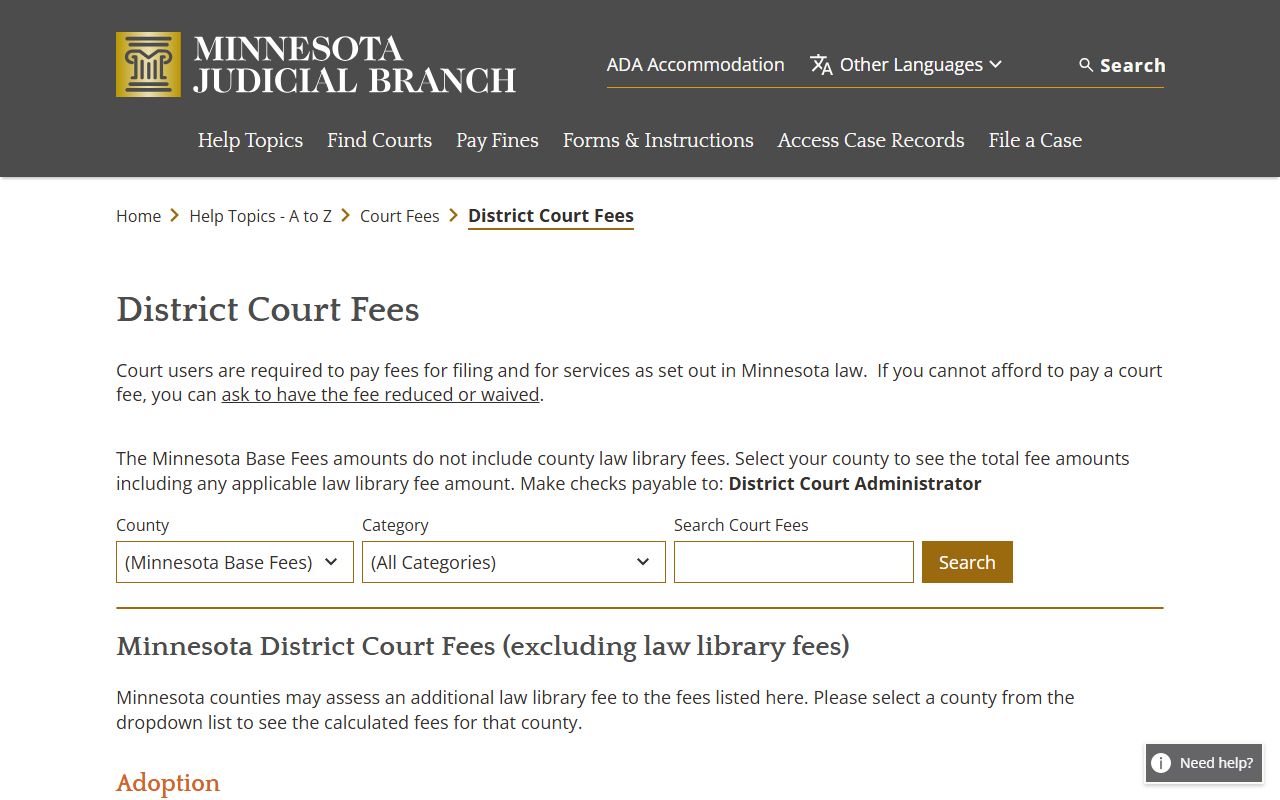
Because fee pages change, a user should verify the current amount before mailing a payment or appearing at the counter.
| Item | Amount or note |
|---|---|
| Certified court copy | $14 base fee shown in Minnesota district court fee examples; verify Fillmore current total. |
| Exemplified and certified court copy | $28 base fee shown in Minnesota district court fee examples; verify current total. |
| Marriage license | $125, or $50 with qualifying premarital education documentation. |
| Marriage certificate | $9 per certificate through the Auditor-Treasurer process. |
| Fingerprinting at jail | $20 cash or check, with photo ID required. |
Fillmore County Sheriff and Jail
The Fillmore County Sheriff's Office and jail are separate from the court clerk function. The sheriff handles law-enforcement duties, contracted services for several cities, jail operations, civil process, fingerprints, permits, suspicious activity reports, and sheriff records. The Fillmore County Jail page links jail-related topics, and the current inmate roster page states that the roster is updated daily. The jail FAQ gives practical rules on visitation, inmate mail, phone cards, VINE, fingerprinting, warrants, first appearances, bail, and bond.
The court record may show charges and hearings after a case opens, while jail records show current custody information. Sentenced state prisoners and supervised adult DOC offenders use Minnesota DOC search tools, not the county jail roster. Federal custody uses the Bureau of Prisons locator. For arrest-to-charge context, use sheriff records, jail roster details, MCRO, and BCA criminal-history search together rather than treating one database as complete.
The official Fillmore County homepage is the county gateway for sheriff, jail, data privacy, recorder, and other local office pages.
The county site is also where local news, department links, and administrative notices appear, so it is a useful confirmation point before relying on older saved information.
Fillmore County Marriage Divorce Probate
Marriage records and divorce records are not held in the same place. Fillmore County marriage licenses and marriage certificates are handled through the Auditor-Treasurer and the Minnesota Official Marriage System. Both applicants must appear for the oath and signature step unless the office authorizes another procedure. Divorce and dissolution files are District Court records, so public case status and registers are searched through MCRO, with certified divorce decrees requested from Court Administration.
Probate files are also District Court records in Fillmore County. The Probate Division of District Court covers estates, wills, informal probate, formal probate, guardianship, conservatorship, and related filings. Minnesota probate guidance separates informal probate, often used for less complicated estates, from formal probate, which involves a petition and hearing before a judge. Public probate case data may appear in MCRO, while restricted guardianship, conservatorship, medical, financial, and civil commitment details may stay sealed or unavailable online.
- Personal representative
- The person appointed to administer an estate.
- Informal probate
- A probate path that asks for appointment without a judge's hearing in less complex matters.
- Formal probate
- A probate petition process with a hearing, often used when issues are disputed or more complex.
Fillmore County Data Requests
Some records that matter to a court, charge, or public-record search are not Judicial Branch records. Fillmore County Administration/HR identifies the County Administrator as the public information and data privacy officer. The county Data Privacy page links a data information disclosure request form, a guide for members of the public, and an information guide about data about you. Sheriff records have a separate practical path through the Sheriff's Office Data Request Form described on the sheriff services page.
Use county data channels for county-government records, not for certified court filings. Use sheriff data channels for incident reports, booking-related law-enforcement data, or sheriff documents that are not posted online. Use Court Administration for case records, calendars, certified copies, and court file questions. This split keeps a request from being sent to the wrong public office.
The Fillmore County Data Privacy page provides the local county-government disclosure route.
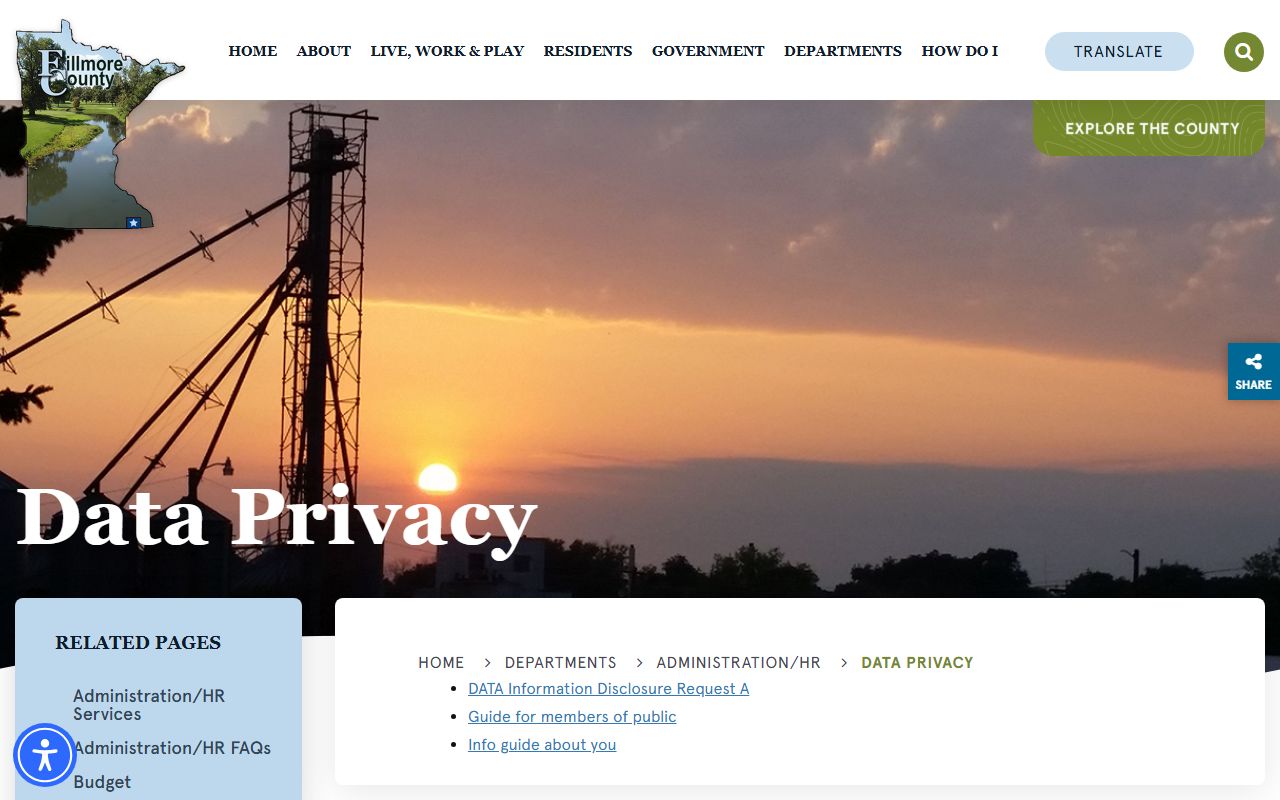
That route is most useful for county data held by county departments rather than by Minnesota's state court system.
The county Administration and HR services page identifies the administrator function tied to public information and data privacy.

For a practical request, name the office likely to hold the file, describe the record clearly, and include a case number, incident number, date, or party name when available.
Fillmore County Court History
Fillmore County's official history gives the court and record system a strong local setting. The county seat moved from Chatfield to Carimona before voters chose Preston in 1856. Preston citizens decided in 1863 to build a brick courthouse on a public square, and two wings were added in 1884. The present courthouse was erected in 1958 on the same site. Later county construction created more office space, and a courthouse addition, remodel, and mechanical upgrade followed heightened security concerns after September 11, 2001.
The official Fillmore County history page documents the county seat and courthouse timeline.
That history explains why court, attorney, recorder, administration, planning, and other county offices remain clustered around the courthouse and county office complex in Preston.
Common Fillmore Court Terms
Court records use short terms that can hide important differences. A charge is an allegation filed in court. A conviction is a judgment of guilt after a plea or finding. A disposition is the outcome of a case or charge. A Register of Actions is the chronological court docket. A warrant is a court order authorizing arrest, search, or another act, but a warrant entry can be sealed or not remotely visible.
| Term | Plain meaning |
|---|---|
| Complaint | The opening pleading in a civil case or charging document in a criminal case. |
| Docket entry | One event in the court case history. |
| Disposition | The result of a case or a specific charge. |
| Expungement | A process that seals qualifying records from public view. |
| Restitution | Money ordered to compensate a victim. |
Fillmore County Court FAQs
Where are Fillmore County court records searched online?
Use MCRO Case Search for District Court case records, Hearing Search for dockets, Document Search for online public documents by case number, and Judgment Search for public monetary judgments. Select Fillmore as the county when a county-only search is needed.
Who provides certified Fillmore County court copies?
Certified court copies come from Fillmore County Court Administration, not from MCRO screenshots. The local office is at the Fillmore County Courthouse in Preston and is the route for certified copies, courthouse-only documents, and calendar questions.
Are Fillmore County warrants searchable online?
No official public Fillmore County active-warrant search database was found in the research. The jail FAQ points people to Court Administration's warrant number or the Detention Center. MCRO may show public warrant-related case entries when the case number is known.
Are marriage and divorce records held by the same office?
No. Marriage licenses and certificates are handled by the Auditor-Treasurer and MOMS. Divorce files and certified divorce decrees are District Court records handled through MCRO and Court Administration.